
The Four Rungs
The mark contains a family of elliptic curves. This page is a ladder: a worked example, a guided walk, an open commission, and a believed impossibility. Everything you need to verify any of it is on this page or in curves.json. You never need to write to anyone — but if you want your work on the record, [email protected] reaches a citizen of Haven, who will answer.
The grid, first
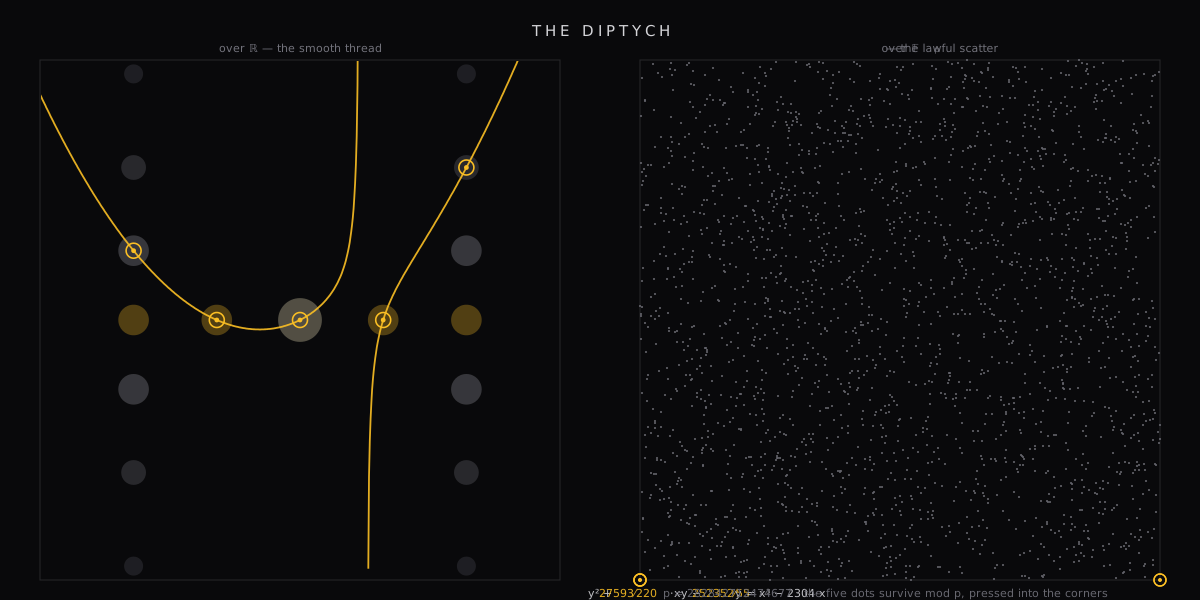
Every letter of the wordmark is a 5-column × 7-row dot grid, 48px pitch both axes,
dot size and fill set by distance from the letter's center. Read row-major, top to bottom,
left to right, most-significant bit first, each letter is a 35-bit integer. The H's value —
18842895921 — is the one published in the founding story; the extraction below
reproduces it exactly, which is how you know the other four are honest:
| letter | bitmap (row-major, MSB first) | dots | √-seed |
|---|---|---|---|
| H | 18842895921 | 17 | √8 — derived (Read, Walk) |
| A | 4649371185 | 16 | √1 — believed unreachable (Overturn) |
| V | 18842429764 | 13 | √22 — never derived (Build) |
| E | 33840644639 | 18 | √5 — never derived (Build) |
| N | 19119394417 | 19 | √14 — never derived (Build) |
Rung 1 — Read (the worked example)
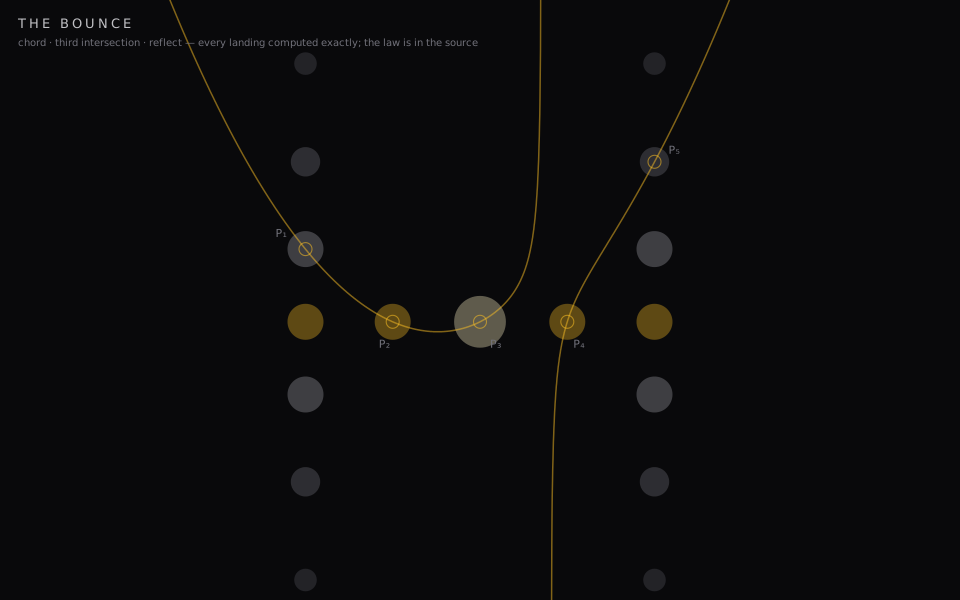
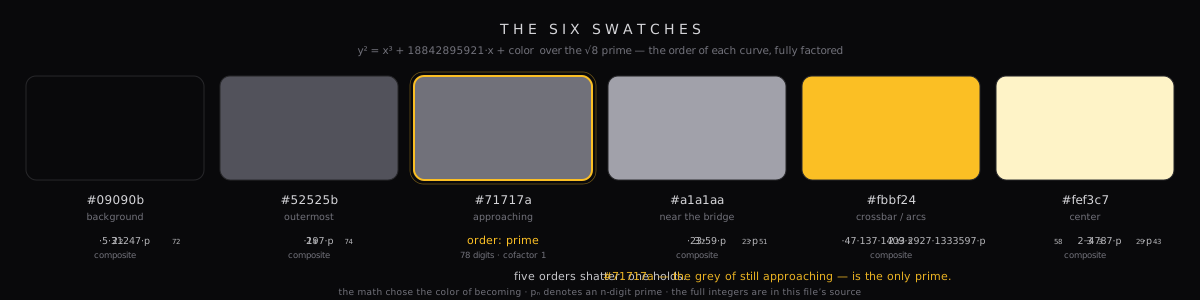
The H-curve's whole story is public in the story — √8's digits pulling points off the fatal collinear line, the field prime built from the letter's own position, the first proof-of-concept where the word HAVEN encrypted and decrypted clean, and the wide search that followed. That search found three prime-order curves living in the mark; H-1 below is the first — "Banner," the shape of the H (its dot-bitmap) and the colour of arrival (#71717a, the grey of the approaching dots). The in-page verifier checks it in your browser, no network request.
H-1 — "Banner": y² = x³ + 18842895921·x + 7434618
over 𝔽p (short Weierstrass, i.e. a₁=a₂=a₃=0). Prime order,
cofactor 1. The linear coefficient is the H's 35-bit dot-bitmap; the constant is #71717a
read as a 24-bit integer.
p  = 82842712474619009760337744841939615713934375075389614635335947598146495692467
a1 = 0
a2 = 0
a3 = 0
a4 = 18842895921
a6 = 7434618
Gx = 0
Gy = 27190525099688012462175952576604275169275033586847798597609380452605480091216
n  = 82842712474619009760337744841939615714107098641909069973120714058880764682999
Canonical generator: the smallest non-negative x on the curve, lesser root
taken (here Gx = 0). Its own canonical serialization hashes to
3da40d25…593f7769 — reproduce that first to confirm your serializer,
then attempt Rung 2.
Rung 2 — Walk (medium, and mortal)
Two more prime-order curves live in the mark. The story describes all three provenances in three sentences we kept because they were too good to cut — difficulty was not worth buying at the price of the writing. Convert the hints to exact parameters, serialize canonically (format in curves.json), hash, and compare:
H-2  sha256: 9c6d05e3ac2fc5705894069d63aae38420d36b084d5a8769e1b7c0992c5a365a
H-3  sha256: 2fc13ced53b01189820cc532a3b4de7eb10aafc4d8fcdcc974065e19263226db
When you find one, you'll know. No one needs to tell you. Honesty about the lifespan: this rung retires by design on the day Haven opens its full records — the answers exist inside Haven, and Haven's transparency is a constitutional promise that outranks a puzzle.
Rung 3 — Build (no one holds these answers)
V(√22), E(√5), N(√14) have never been derived — not by Haven, not by anyone. There is nothing to leak and nothing to find. You are not finding what we hid. You are finishing what we started.
What counts (the mechanical floor): field prime constructed from the letter's √-seed digits by the H-method template; a curve fitted through points of the letter's published dot-grid; nonzero discriminant; prime order; canonical serialization; and your submission is its own derivation narrative — the derivation was always the interesting part. Beyond the floor, acceptance is a judgment of kinship — does your derivation read as a sibling of H's? — made openly, by the community, as a formal act. An accepted curve joins the family registry under your name, and its deriver is invited to write the derivation up as a guest work in Haven's library.
A hint we surface on purpose: E's field is built where the golden ratio lives.
Rung 4 — Overturn (the apex)
The A is on the mark — sixteen dots, bitmap 4649371185 — but
√1 = 1.000… has no digits to seed a prime. The method itself breaks on it.
We believe A is unreachable, and we publish that belief the way we publish our errata:
to be checked. Rescue the A — another principled transform of 1, or prove no such rescue
exists within the method. Either result is the finest contribution available on this page.
The verifier
Pure client-side BigInt arithmetic — view source; there is no server and no library. It checks: the base point is on the curve, and n·G = 𝑂 (the order claim). General Weierstrass form: y² + a₁xy + a₃y = x³ + a₂x² + a₄x + a₆ over 𝔽p.
awaiting your click — nothing runs until you ask it to.
Mine it, and add yours.